

WEBMD – Skin cancers — including melanoma, basal cell carcinoma, and squamous cell carcinoma — often start as changes to your skin. They can be new growths or precancerous lesions — changes that are not cancer but could become cancer over time.
An estimated 40% to 50% of fair-skinned people who live to be 65 will develop at least one skin cancer. Learn to spot the early warning signs. Skin cancer can be cured if it’s found and treated early.
Actinic Keratosis (Solar Keratosis)
These small, scaly patches are caused by too much sun, and commonly occur on the head, neck, or hands, but can be found elsewhere.
They can be an early warning sign of skin cancer, but it’s hard to tell whether a particular patch will continue to change over time and become cancerous. Most do not, but doctors recommend early treatment to prevent the development of squamous cell skin cancer. Fair-skinned, blond, or red-haired people with blue or green eyes are most at risk.
Actinic Cheilitis (Farmer’s Lip)
Related to actinic keratosis, actinic cheilitis is a precancerous condition that usually appears on the lower lips. Scaly patches or persistent roughness of the lips may be present.
Less common symptoms include swelling of the lip, loss of the sharp border between the lip and skin, and prominent lip lines. Actinic cheilitis may evolve into invasive squamous cell carcinoma if not treated.
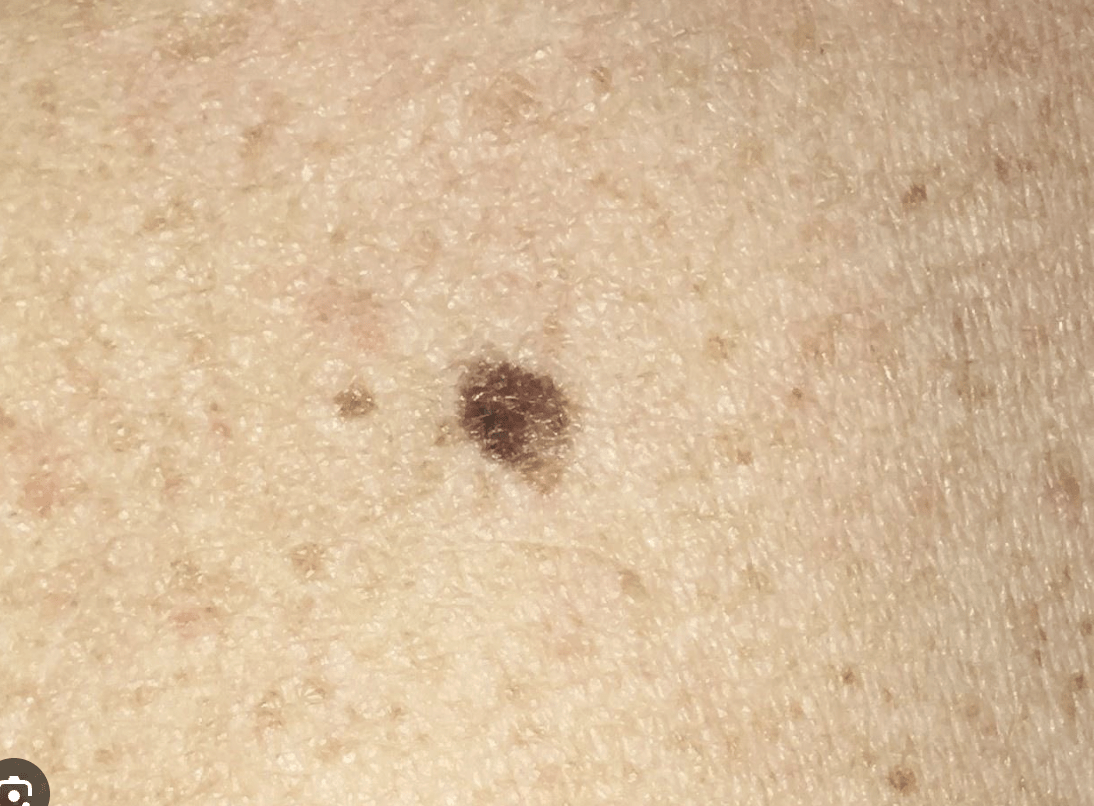
When Is a Mole a Problem?
A mole (nevus) is a benign growth of melanocytes, cells that gives skin its color. Although very few moles become cancer, abnormal or atypical moles can develop into melanoma over time.
“Normal” moles can appear flat or raised or may begin flat and become raised over time. The surface is typically smooth.
Moles that may have changed into skin cancer are often irregularly shaped …